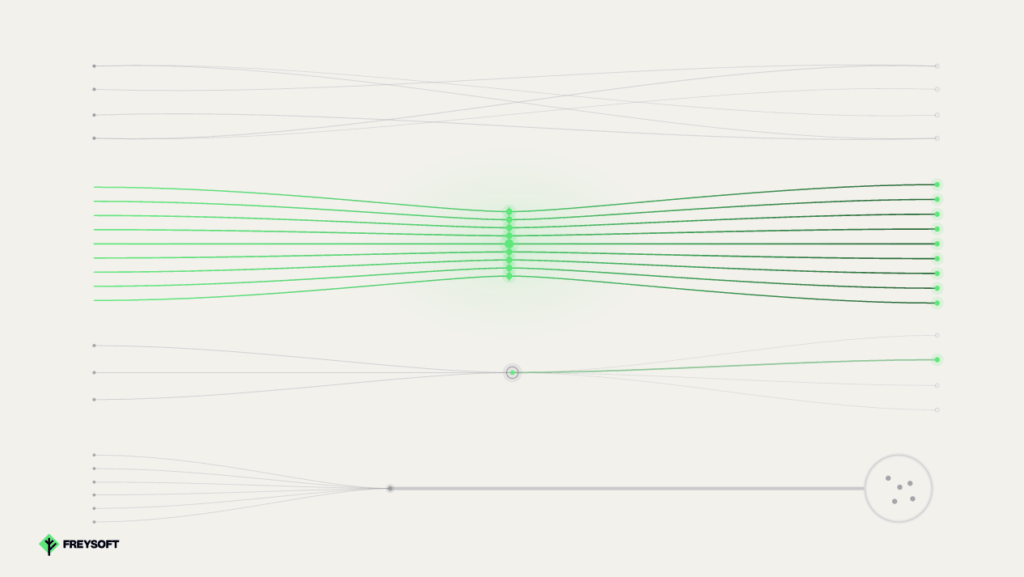
Four architectures, four trade-offs — and what it really takes to get from corridor #3 to corridor #20.
Adding a payment corridor sounds like a feature. It is actually an architecture decision, and the cost of getting it wrong does not show up on corridor #1 — it shows up on corridor #4, when the approach that felt fast at the start has quietly become the thing slowing every new market launch.
A payment corridor is the full engineering path that moves money between two markets: the connection to a banking or payout partner in the destination country, the rail or rails used to settle, the currency handling, the reconciliation that proves the money arrived, and the failure handling for when it doesn’t. “Adding a corridor” means standing all of that up and then keeping it running 24/7. The interesting question is not whether you can build one. It is which of four architectures you use to add the next nineteen.
The four architectures for connecting corridors
1. Point-to-point
The first instinct, and the right one for corridor #1. You wire the banking partner or rail directly into your core platform — bespoke integration, bespoke data mapping, bespoke error handling.
It is the fastest way to ship a single corridor. It is also a trap that springs on a schedule. Every new partner adds another direct coupling into core; every change to one integration risks rippling into others; and by the third or fourth corridor your engineers spend more time defending the existing connections than building new ones. Point-to-point scales linearly in effort and worse than linearly in fragility.
Use it for: your first one or two corridors, or a deliberately tiny, stable set you will never grow.
2. Canonical adapter (hub) model
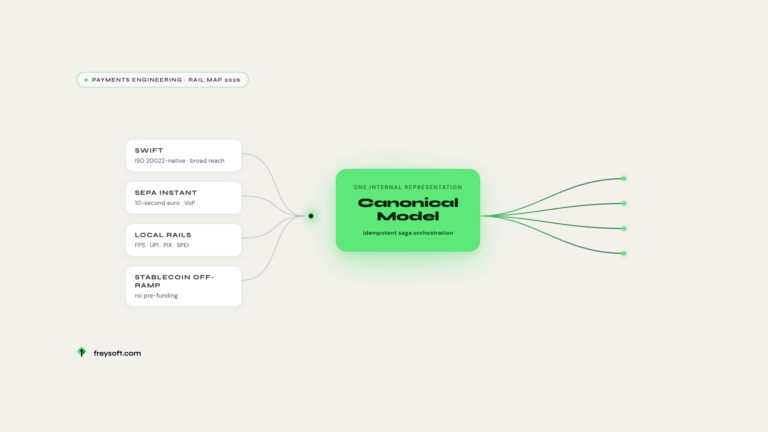
The first real architecture. Instead of wiring each partner into core, you define an internal canonical payment model — your own representation of a transfer, independent of any partner — and write one thin adapter per banking partner or rail that translates between the partner’s interface and your canonical model.
Core only ever speaks your canonical language. Adding a corridor becomes “write another adapter,” not “modify core again.” The blast radius of any one partner’s quirks is contained inside its adapter. This is the single most important structural decision in corridor engineering, and it is the one most teams skip because point-to-point felt fine at corridor #2.
Use it for: any operator that intends to run more than a handful of corridors.
3. Orchestrated multi-rail routing
On top of the adapter layer, an orchestration engine decides, per transaction, which partner or rail to use — by cost, speed, success rate, liquidity, or destination. This is where “integrated payment solutions” stop being a collection of connections and become a system that optimises itself.
Orchestration is what lets you route a transfer over SWIFT/gpi, SEPA Instant, a local instant scheme, or an emerging stablecoin off-ramp depending on what is cheapest or fastest at that moment, and fail over cleanly when a rail is down. It is also genuinely hard to build well (more on that below), which is why payment orchestration providers exist as a buy option — and why building your own only pays off when routing is a differentiator rather than a commodity.
Use it for: operators where routing intelligence across multiple rails is part of how they compete.
4. Aggregator-abstracted
The buy end of the spectrum: hand the corridor to a payout aggregator or network (the dLocals and Thunes of the world) that already has the destination connections. You integrate once with the aggregator and inherit its coverage.
Fast and low-effort for reach you would struggle to build. But you inherit the aggregator’s pricing, its coverage gaps, and its corridor-level corridor pricing economics — and you do not own the path. At volume, on corridors that matter to your margin, the per-transaction cost and the loss of control become the constraint.
Use it for: corridors that are table stakes, low-volume, or in markets too costly to build directly.
The trade-offs, side by side
| Architecture | Time to first corridor | Cost at scale | Control / IP | Reliability ownership |
|---|---|---|---|---|
| Point-to-point | Fastest | Worst (rework) | Full | Yours, but fragile |
| Canonical adapter | Moderate | Good | Full | Yours, contained |
| Orchestrated routing | Slowest to build | Best at volume | Full | Yours, engineered |
| Aggregator-abstracted | Fast | Worst per-tx at volume | Low | Theirs |
The pattern most scaling operators converge on is canonical adapters with an orchestration layer on top — owned, contained, and optimisable — using aggregators selectively for corridors that are not worth building. The mistake is staying on point-to-point past corridor #3 because each individual integration still felt manageable in isolation.
The reliability engineering that decides survival
Architecture gets a corridor live. Reliability engineering decides whether it survives contact with production volume. Four things separate a corridor that works in a demo from one that runs at scale:
- Idempotency. Banking partners and rails will send duplicate and retried callbacks. Every webhook handler needs an idempotency key, or you will eventually double-process a payment — the single most expensive class of bug in this domain.
- Saga orchestration. A cross-border transfer is a multi-step, long-running flow that must either complete fully or compensate cleanly. Naive sequential calls leave money in indeterminate states. Sagas make “complete or unwind” a property of the system, not a hope.
- Observability. When a transfer fails at 3am, you need to reconstruct exactly which step, which partner, and which decision produced the failure — after the fact. Corridors without deep observability are debugged by guesswork.
- Reconciliation. Every day, across every rail, the money you think moved must match the money that actually moved. Reconciliation drift is silent until it is a regulatory problem.
A corridor architecture that ignores these is not faster — it is slower, with the cost deferred to the first incident at scale.
Scaling from corridor #3 to corridor #20
The whole point of the canonical-adapter model is the reusable connector pattern: each new corridor reuses the same core, the same orchestration, the same reliability primitives, and adds only a thin, well-bounded adapter. Corridor #20 should cost a fraction of corridor #3, not the same amount. If adding corridors is not getting cheaper as you go, your architecture is wrong, and no amount of additional engineers will fix it — they will just produce fragility faster.
What this looked like in production: WorldRemit
This is the engineering FreySoft ran for WorldRemit (now Zepz), a cross-border remittance business operating across 130+ countries and 70+ currencies. As WorldRemit expanded into new markets, the work was exactly the corridor problem described above: connecting banks and financial institutions in target locations, establishing transfer corridors, and keeping them running reliably around the clock.
FreySoft embedded with WorldRemit’s team to build and maintain those corridors — connecting banking partners in new countries, optimising the codebase to operate 24/7, and processing over 100,000 payment transactions a day with the corridor reliability that volume demands. The team also migrated services from Azure to AWS, reducing infrastructure cost in the process. The corridor logic was built into WorldRemit’s own platform and owned by WorldRemit.
There is a continuity worth noting: Mark Watson, CTO of WorldRemit during 2018–2022, went on to become CTO of ComplyAdvantage. The same engineering relationship has therefore spanned both the payments and the compliance sides of cross-border money movement — the kind of cross-domain depth that corridor work, done properly, builds.
The decision in one line
Use point-to-point for your first corridor, move to a canonical adapter model before corridor #3, add orchestration when routing becomes a differentiator, and use aggregators only for corridors not worth owning. Then invest in the reliability engineering — idempotency, sagas, observability, reconciliation — that decides whether any of it survives at volume.
Get the architecture right early and corridor #20 is cheap. Get it wrong and you will rebuild it under a deadline, somewhere around corridor #4.
Weighing whether to build this in-house or embed a partner who has shipped it before? See “Choosing a payment engineering partner: build, buy, or embed.”