A 2026 decision framework for cross-border payment operators
Every cross-border payment operator hits the same wall eventually. The first corridor is exciting. The second is manageable. By the third or fourth, the questions stop being “can we ship this?” and start being “who should be building this, and how?”
That is a partner-selection decision, not a coding decision — and it is usually made under pressure, with a product roadmap that assumed payments would “just work.” This guide lays out the three real options in front of you — build, buy, or embed — what each genuinely costs, where each one breaks, and how to choose between them without learning the answer the expensive way.
Contents
- The three paths, defined
- Build: when payments are your moat
- Buy: when speed beats control
- Embed: the speed of buy, the control of build
- The five-question decision framework
- What “good” looks like in a payment partner
- The WorldRemit case: embed in production
- The bottom line
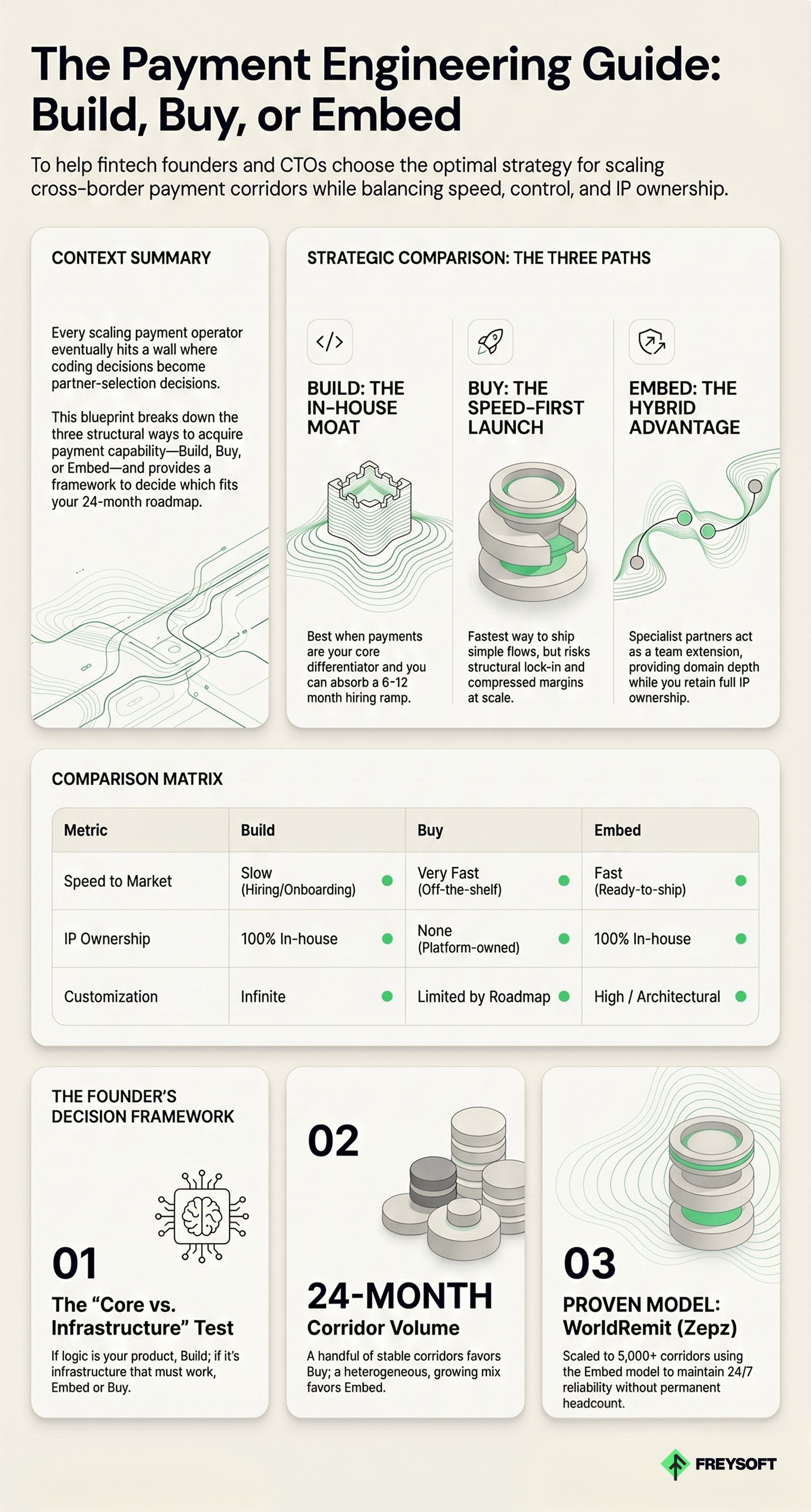
1. The three paths, defined
When a fintech needs new payment capability — a new corridor, a new rail, an orchestration layer, a settlement flow — there are only three structural ways to get it:
- Build. Hire and grow an in-house payment engineering team that owns the logic end to end.
- Buy. Adopt a payment platform, PSP, or orchestration provider that supplies the capability as a product.
- Embed. Bring in a specialist engineering partner that works as an extension of your team, builds the logic you own, and leaves you with the IP and the institutional knowledge.
Most “build vs buy” articles stop at two options. That framing is incomplete, and the gap is exactly where most scaling payment operators actually land. The interesting decision in 2026 is rarely build or buy — it is understanding when the third path is the right one.
2. Build: when payments are your moat
Building your own payment engineering team makes sense when payments are your core differentiator and you have the time and capital to do it properly.
The advantages are real: full control over the roadmap, intellectual property that stays in-house, and engineers who carry deep context about your specific flows. If payment logic is your product — if it is the thing customers pay you for — owning it outright is defensible.
The costs are equally real, and they are usually underestimated:
- Hiring is slow. Senior cross-border payment engineers are among the hardest roles in fintech to fill. A serious hire — someone who has actually shipped SWIFT, SEPA Instant, local rails, and reconciliation in production — can take six to twelve months to find and onboard.
- It is expensive. A senior payment engineer in the US or UK is one of the most costly individual contributors on the org chart once you load benefits, equity, and management overhead.
- Key-person risk concentrates. Two or three engineers end up holding the entire corridor architecture in their heads. When one leaves, corridor velocity stalls.
Build is the right answer when payments are your moat and you can absorb a 6–12 month ramp. It is the wrong answer when the market is moving faster than your hiring pipeline.
3. Buy: when speed beats control
Buying — using a payment platform, PSP, or payment orchestration provider — is the fastest way to get moving and the lowest upfront commitment.
For early-stage products, simple flows, or a small, stable set of corridors, this is often the correct choice. The provider handles the rails, the compliance plumbing, and the maintenance. You ship in weeks, not quarters.
Where buying breaks is at scale, and it breaks predictably:
- You do not own the logic. Your routing, your retry behaviour, your corridor-specific edge cases — they live inside someone else’s product, configured the way that product allows.
- Customisation hits a ceiling. The moment your corridor mix needs something the platform does not natively support — an unusual local rail, a bespoke settlement path, a stablecoin off-ramp — you are filing a feature request and waiting.
- Margins compress as volume grows. Per-transaction pricing that felt trivial at 10,000 transactions a month is a line item the CFO circles at 10,000,000.
- Lock-in is structural. Migrating off a payment platform once it is woven through your product is a multi-quarter project that nobody wants to staff.
Buy is the right answer when speed matters more than control and your corridor needs fit inside what the platform offers. It is the wrong answer when your differentiation depends on doing something the platform was not built to do.
4. Embed: the speed of buy, the control of build
The option most growth-stage payment operators actually need sits between the other two. Embed means engaging a specialist engineering partner that operates as an extension of your team — building the corridor and rail logic to your architecture, on your codebase, with your engineers — and leaving you owning the result.
Done well, embedding combines the speed of buying with the control of building:
- Speed of buy. A specialist partner who has shipped cross-border payments before does not need a 6–12 month ramp. They have already made the mistakes elsewhere.
- Control of build. The logic lives in your codebase. You own the IP. There is no per-transaction tax and no platform lock-in.
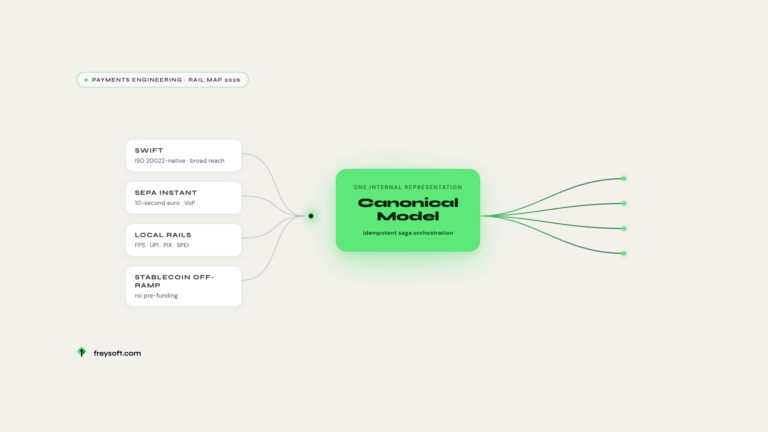
- Domain depth on demand. You get engineers who already understand idempotent webhooks, saga orchestration, reconciliation, and corridor reliability — without carrying that headcount permanently.
Underneath the mechanics sits a principle that matters more than any of them: in a technology business, you cannot fully outsource the part that makes the business yours. There has to be an owner inside the company — someone who holds the architecture and the why, not just the budget line. A good embed partner is an extension of that owner; it accelerates the build, it does not take the wheel. Hand the whole thing to an outside team and you no longer have a contractor — you have a de facto co-owner, and you have given away the part of the business that was supposed to be your edge. Embed works precisely because ownership stays with you.
The catch is that embedding is only as good as the partner. A generalist development shop assigned to a payment project will rebuild the same mistakes an in-house team would, just on someone else’s invoice. The entire value of the embed path depends on choosing a partner with genuine payment domain experience — which is the decision the rest of this guide is about.
5. The five-question decision framework
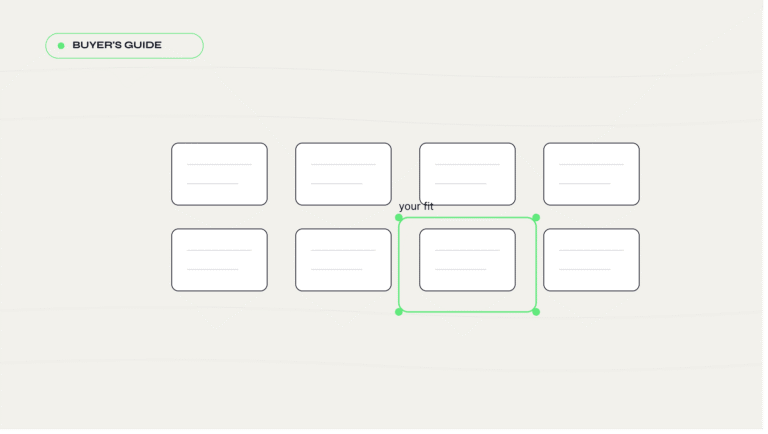
Before evaluating any payment solution providers or engineering partners, answer these five questions internally. They determine which path fits.
- Is payment logic your core differentiator, or a capability you need reliably? If it is the product, lean build. If it is infrastructure that must work, lean embed or buy.
- How many corridors and rails will you run in 24 months? A handful of stable corridors favours buy. A growing, heterogeneous mix — local rails, instant schemes, stablecoin settlement — favours build or embed, because off-the-shelf coverage runs out.
- What is your real time-to-market pressure? If a competitor ships a corridor before you, what does it cost? High urgency rules out the slow ramp of pure build.
- Do you need to own the IP? If your valuation, audit posture, or strategic independence depends on owning the payment logic, buying is off the table.
- Do you have senior payment engineering capacity today — and can you hold it? If yes, build is viable. If you cannot reliably hire and retain it, embedding gives you the depth without the permanent headcount.
There is no universally correct answer. There is a correct answer for your corridor roadmap, your time pressure, and your IP requirements — and these five questions surface it.
6. What “good” looks like in a payment partner
If the framework points you toward embed (or toward augmenting an in-house build), the selection criteria matter more than the engagement label. A credible payment engineering partner should be able to demonstrate:
- Production cross-border payment experience — not adjacent fintech work, but corridors, rails, and settlement shipped and maintained in production.
- Reliability engineering depth — idempotency, saga orchestration, observability, and 24/7 operation, because corridors that work in a demo and fail at volume are worse than no corridor.
- A reusable connector pattern — so adding corridor #20 does not mean rewriting the platform you built for corridor #3.
- A delivery model that leaves you owning the IP — the partner builds with you, not instead of you.
- Regulatory-aware engineering — for EU operators, that increasingly means DORA-native practices and engineers who understand the compliance surface they are building against.
7. The WorldRemit case: embed in production
This is the path FreySoft has run in production. WorldRemit (now Zepz) is a digital cross-border remittance business operating across 130+ countries and, today, more than 5,000 money transfer corridors. As it expanded into new markets, it needed to connect banks and financial institutions in target locations and establish corridors that ran reliably, around the clock.
FreySoft embedded with WorldRemit’s team to build and maintain corridors in new markets. The work included connecting banking partners in new countries, optimising the codebase to operate 24/7 with the reconciliation and retry logic that keeps money movement consistent, and an Azure-to-AWS migration that reduced infrastructure spend. The corridor logic was built into WorldRemit’s platform, owned by WorldRemit, and maintained as the corridor count grew — the embed model in practice: built with them, not instead of them.
8. The bottom line
If payments are your moat and you can hold the talent, build. If your corridor needs are simple and speed beats control, buy. If you need production-grade cross-border payment capability quickly, want to own the logic, and cannot justify permanent senior payment headcount — embed with a partner that has done it before.
The expensive way to learn this is to buy when you should have embedded, discover the ceiling at corridor #4, and rebuild under deadline. The five questions above are cheaper.