What “24/7 corridor reliability” actually requires — and why uptime is an engineering decision, not a marketing claim
“Integrated payment solutions” is one of the most overused phrases in fintech, and one of the least examined. Every provider claims them. Far fewer can say what integrated and reliable actually cost in engineering terms. For a cross-border payment operator, the phrase has a precise meaning: a corridor that moves money correctly, every time, around the clock — and “around the clock” is where most of the real work hides.
This piece is about the reliability half of integrated payment solutions: what 24/7 corridor operation genuinely requires, and why it is an architecture and operations decision long before it is a marketing line.
Reliability is a number, not an adjective
Start by being honest about what “reliable” means. A corridor running at 99% uptime is down roughly 3.65 days a year. At 99.9% it is down about 8.8 hours a year. At 99.99% — the kind of figure cross-border operators actually need — it is down under 53 minutes a year. Each additional nine is an order of magnitude more engineering, not a slightly better effort.
For money movement, the cost of downtime is not just unprocessed volume. It is stranded transactions, failed customer payouts, reconciliation gaps, and — at enough scale — regulatory attention. Reliability is a quantified target with a quantified cost of failure, and it should be designed to, not hoped for.
What 24/7 corridor reliability actually requires
Four layers of engineering stand between “it works in business hours” and “it runs at four nines.”
1. Redundancy at every external dependency
A corridor depends on banking partners, rails, and infrastructure — each of which will fail eventually. Reliable corridors assume failure: multiple routing options per destination (see cascading failover), no single banking partner as an unguarded single point of failure, and infrastructure that survives the loss of a node, a zone, or a region. The WorldRemit work included an Azure-to-AWS migration precisely because infrastructure choices are reliability choices.
2. Idempotency and safe retries
24/7 operation means automated retries, and automated retries mean duplicate-processing risk. Every operation that moves or records money must be idempotent — safe to attempt more than once with the same result. Without it, the very mechanism that keeps a corridor running unattended at 3am is the mechanism that double-pays a customer.
3. Saga orchestration for clean failure
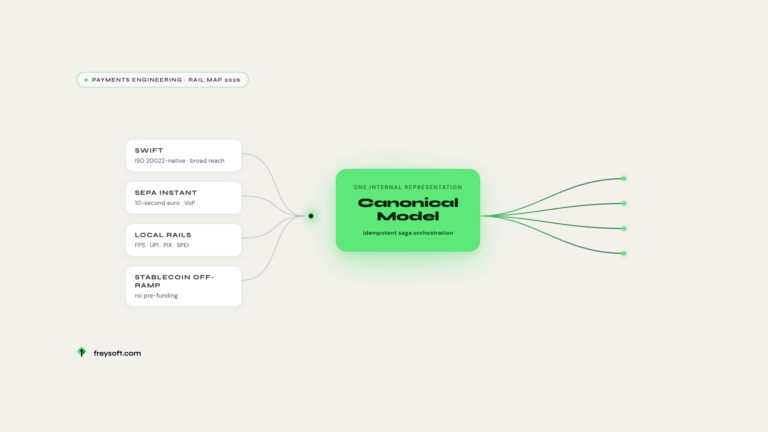
When a multi-step transfer fails partway at 3am with no engineer watching, the system itself must resolve it — complete the remaining steps or compensate the completed ones. Saga orchestration makes “no money left in limbo” a structural guarantee rather than a morning clean-up task. This is the difference between a corridor that self-heals and one that accumulates a backlog of stuck transactions overnight.
4. Observability and incident response
You cannot operate what you cannot see. Reliable corridors carry deep observability — tracing every transaction across every hop, alerting on anomalies before customers notice — paired with the operational layer that is easy to forget in architecture diagrams: on-call rotations, runbooks, and incident response. Four nines is as much an operational commitment as an architectural one.
Reconciliation: the reliability you can’t see
The most insidious reliability failure is the one that looks like success. A corridor can report every transaction as completed while the money it claims to have moved quietly diverges from the money that actually moved. Reconciliation — daily, automated, per-rail matching of intended against actual movement — is the control that catches this. Reconciliation drift is silent until it becomes a regulator’s question, which is why reliable integrated payment solutions treat it as a first-class system, not an accounting afterthought.
Why “integrated” and “reliable” are the same decision
The reason these belong in one article is that integration architecture determines reliability ceiling. A point-to-point corridor cannot easily reach four nines, because failure handling is scattered across every integration and there is no central place to make retries safe or routing redundant. An orchestrated corridor — canonical adapters, central routing, shared reliability primitives — can, because reliability is engineered once and inherited by every corridor.
That is what genuinely integrated payment solutions mean: not “we connect to many things,” but “reliability is a property of the system, so every corridor inherits it.” The phrase is only worth anything if the architecture behind it earns the claim.
What this looked like at scale
FreySoft built and maintained the transfer corridors behind WorldRemit (now Zepz) to run reliably 24/7 across 130+ countries and 70+ currencies, processing over 100,000 payment transactions a day. Reaching and holding that reliability bar at that volume — through redundancy, idempotency, saga orchestration, observability, and reconciliation — is what “integrated payment solutions” means when the phrase is backed by engineering rather than marketing.
The takeaway
Treat reliability as a number with a cost, not an adjective. Engineer for it in four layers — redundancy, idempotency, saga orchestration, observability — and back it with reconciliation and real incident response. And recognise that your integration architecture sets your reliability ceiling: you cannot bolt four nines onto a point-to-point tangle. Integrated and reliable are not two features. They are one decision.
Building corridors that have to run 24/7? See the architecture overview, “How fintechs actually add new payment corridors,” or talk to our payments team.