The reusable connector pattern that makes each new corridor cheaper — and why a generalist team can’t deliver it
There is one number that tells you whether your corridor architecture is sound, and it is not uptime or transaction volume. It is this: does each new corridor cost less than the last one?
If corridor #20 costs roughly what corridor #3 cost, your architecture is failing — quietly, expensively, and in a way that more engineers will not fix. If corridor #20 costs a fraction of corridor #3, you have built the thing that actually matters in cross-border payments: a system that scales sub-linearly. This piece is about the engineering pattern that produces that curve, and why the choice of who builds it determines whether you get it.
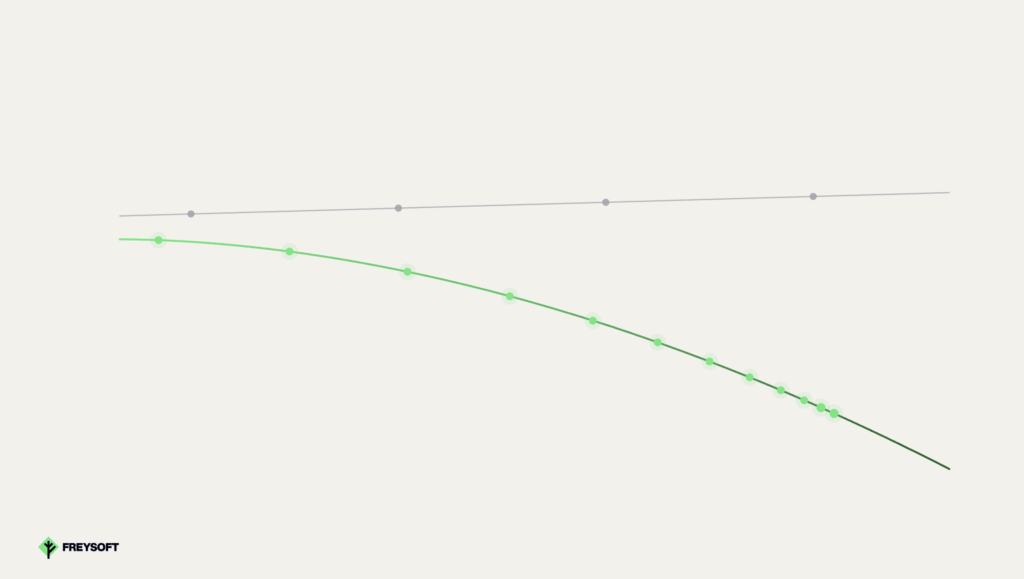
The two cost curves
Every cross-border operator is on one of two trajectories.
The linear curve (or worse). Each corridor is built largely from scratch — its own integration logic, its own error handling, its own reliability code. Corridor #20 costs about what #3 cost, sometimes more, because the accumulated complexity makes every addition riskier. This is the point-to-point trajectory, and it ends with a roadmap throttled by integration work.
The sub-linear curve. Each corridor reuses a shared foundation and adds only what is genuinely unique to it. Corridor #20 costs a fraction of #3. This is the trajectory that lets a payment operator enter markets as fast as the business can sign banking partners, rather than as fast as engineering can rebuild plumbing.
In short, the difference between the two curves is a single architectural pattern.
The reusable connector pattern
The pattern has three parts:
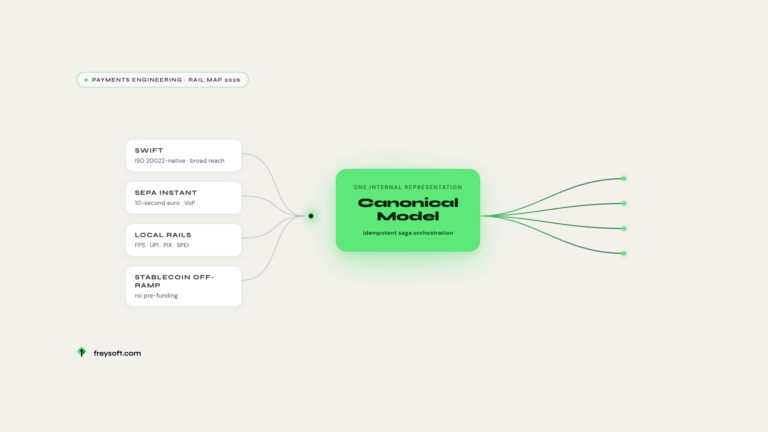
- A canonical core that never changes per corridor. Your platform speaks one internal model of a transfer. Adding a corridor does not touch it.
- Thin, bounded connectors per partner or rail. Each new corridor is a connector that translates between a specific partner and the canonical model — and only that. A connector contains the partner’s quirks; it does not leak them into the system.
- Shared reliability and orchestration primitives, inherited by every connector. Idempotency, saga orchestration, observability, reconciliation, routing — built once, centrally, and reused. A new corridor inherits all of it for free.
In practice, the result is that the unique work of adding corridor #20 shrinks to the genuinely corridor-specific 10–20%: this partner’s API, this rail’s settlement timing, this market’s local quirks. The other 80–90% — the hard, reliability-critical engineering — is already done and battle-tested. That is why the curve bends down.
Why this is a domain skill, not a generic one
Here is the part that decides who should build it. The reusable connector pattern looks, on a whiteboard, like ordinary good software architecture — abstraction, separation of concerns, reuse. Any competent engineering team can draw it.
Building it correctly for payments is a different thing, because the pattern only pays off if the shared primitives are right, and getting them right requires knowing — in advance — where cross-border payments break:
- Knowing that webhooks must be idempotent before a partner sends a duplicate, not after a double-payment incident.
- Understanding which steps of a transfer need saga compensation before money strands at 3am.
- Anticipating what reconciliation must check before drift becomes a regulator’s question.
- Deciding which corridor-specific quirks belong in the connector and which belong in the core — a judgement call that, made wrong, leaks complexity everywhere.
By contrast, a generalist development team builds the abstraction and then learns these lessons the expensive way — corridor by corridor, incident by incident — baking the wrong assumptions into the shared layer that every future corridor inherits. The pattern amplifies whatever you put into it. Done by a team with cross-border payment scars, it amplifies hard-won correctness. Done by a generalist team, it amplifies the wrong guesses across all twenty corridors at once.
Ultimately, this is the specialist-versus-generalist distinction in concrete terms: not “specialists are better engineers,” but “specialists already know where this specific domain breaks, so the foundation they build is right the first time — and the foundation is the thing every corridor inherits.”
What the curve looks like in production
For example, FreySoft built and maintained the transfer corridors behind WorldRemit (now Zepz) as it expanded across 130+ countries and 70+ currencies, running at over 100,000 payment transactions a day. Reaching 130+ countries is not 130 from-scratch builds — it is a reusable foundation plus bounded per-market connectors, which is the only way corridor count scales into the hundreds without the engineering cost scaling with it. The continuity mattered too: the same engineering relationship spanned years and, through the CTO who later moved to ComplyAdvantage, both the payments and compliance sides of money movement.
The takeaway
Watch the cost of each new corridor. If it is flat or rising, your foundation is wrong, and the fix is architectural, not additional headcount. The reusable connector pattern — canonical core, thin connectors, shared reliability primitives — is what bends the curve down. And because the pattern amplifies whatever correctness you build into its foundation, who builds that foundation is not a commodity decision. Build it with a team that already knows where cross-border payments break, or rebuild it after you find out.
Deciding whether to build this foundation in-house or embed a team that has built it before? See “Choosing a payment engineering partner: build, buy, or embed,” or talk to our payments team.