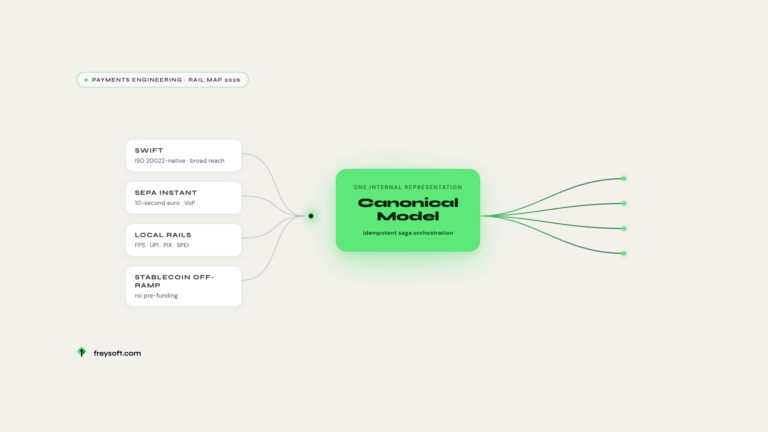
A payment corridor that works in a demo and a corridor that survives production volume are not the same system. The demo moves one clean transfer between two cooperative endpoints. Production moves money across partners that time out, retry, settle late, and occasionally disagree with you about what happened, at a volume where every rare failure mode eventually shows up.
The gap between the two is filled by four engineering patterns: idempotency, saga orchestration, observability, and reconciliation. Get them right and a corridor runs unattended at scale. Get them wrong and the failures are expensive, slow to diagnose, and sometimes invisible until a regulator asks a question you can’t answer.
We built and maintained the transfer corridors behind WorldRemit (now Zepz) : 130+ countries, 70+ currencies, optimised to run 24/7 at over 100,000 transactions a day. The four patterns below are what that kind of volume demands, not what would be nice to have.
Pattern 1. Idempotency
An operation is idempotent when running it more than once has the same effect as running it once. In a payment corridor this isn’t a nicety – it’s the difference between paying someone once and paying them twice.
Partners and rails retry callbacks whenever they don’t receive a timely success response: a dropped connection, a handler that was a little slow, their own retry policy firing. So your webhook endpoint will receive the same “transfer settled” event two, three, or ten times. Handle it naively and each delivery triggers another payout, another ledger entry, another customer notification. The cost isn’t a cosmetic duplicate. it’s real money moved twice, a ledger that no longer balances, and, in a regulated flow, an exposure you have to explain.
What good looks like: every inbound webhook carries an idempotency key, usually the partner’s own event ID, or a hash of (event type + resource ID + status) when they don’t supply one. Before doing any work, the handler checks that key against a dedup store, a unique constraint in the database, or a key in a fast store such as Redis, within a defined dedup window. First time it’s seen: process the event, then persist the key alongside its result. Every time after: return the stored result and run no side effects. The same discipline applies in the other direction. When you call a partner, through your own third-party integration layer, send your idempotency key, so a retry on your side never double-instructs theirs.
Pattern 2. Saga orchestration
A cross-border transfer is not one database transaction. It’s a multi-step, long-running flow across several services and external systems: debit the source, convert the currency, credit the destination rail, confirm, notify. You can’t wrap an external rail call in a database transaction, so you need a different guarantee. A saga provides it. A sequence of local steps where each step has a compensating action that undoes it, giving the whole flow a single property: complete or compensate.
The failure mode this prevents is the one that quietly hurts most. With naive sequential calls, if step three fails after steps one and two succeeded, money has been debited but not credited. It sits in an indeterminate state with no automatic path back. Multiply that by volume and you have a growing backlog of stuck transfers and a queue of manual cleanup that grows faster than the team.
A concrete compensating action: if the destination credit fails after the source debit has already gone through, the compensation reverses the debit, marks the transfer failed, and emits the events the rest of the system depends on. So the customer’s balance, the ledger, and the notifications all end up agreeing. Whether you should adopt an orchestrated saga model in the first place is an architecture decision, and we cover that trade-off in how fintechs actually add new payment corridors. What matters once you have one is the runtime guarantee: every step can be compensated, and the flow never strands money in limbo.
Pattern 3. Observability
Observability is the ability to reconstruct, after the fact, exactly what happened to a single transfer, which step it reached, which partner it touched, which decision the system made and why. Starting the data you already capture, without shipping new code.
The test is the 3am one. A transfer is stuck and a customer is waiting. Can you answer where is it, why, and what do we do next in minutes, from logs and traces you already have? If the honest answer is “add some logging and wait for it to happen again,” you don’t have observability, bacause you have hope.
What to capture at each corridor hop: a correlation ID that follows the transfer across every service and every partner call (distributed tracing, with OpenTelemetry as the common standard). Structured logs keyed to that ID, but not free text, recording the rail, the partner’s response and error code, the retry count, the branch the logic took, and timing at each step. And per-corridor, per-rail metrics, for example: success rate, latency, error rate by partner. You can watch one corridor start to degrade before it becomes an outage, instead of staring at an aggregate that hides it. Operating corridors 24/7 also means the platform underneath has to stay dependable: part of the WorldRemit work was migrating the infrastructure from Azure to AWS, lowering running cost while keeping every corridor live.
Pattern 4. Reconciliation
Reconciliation is the periodic usually daily matching of what your system intended to move against what actually moved according to the partner’s record of truth. It’s the safety net for everything the first three patterns didn’t catch.
The danger is that drift is silent. A transfer that quietly stuck, a partner that reported success but settled a different amount, a fee deducted that you never modelled, none of these necessarily throws an error in real time. They accumulate as drift between your books and the rail’s, and that drift stays invisible until it surfaces as a customer complaint or, worse, an audit question you can’t answer.
What a reconciliation job actually does: it pulls your internal ledger of expected movements for the period, pulls the partner’s settlement report for the same window, and matches on transaction reference, amount, currency, and status. Then it flags the breaks, present in your records but not theirs, present in theirs but not yours, amount or status mismatches, and settlements that landed outside the expected window. This routes every exception to a queue a human investigates. Per-rail, because each rail settles and reports on its own schedule and in its own format, and a single combined view hides exactly the discrepancies you’re looking for.
Architecture gets a corridor live; these patterns keep it alive
Idempotency stops you paying twice. Sagas stop money getting stuck. Observability lets you find the one transfer that did. Reconciliation catches what the other three missed, before it becomes someone else’s problem. They’re the unglamorous engineering that separates a corridor that demos from one that runs unattended at a hundred thousand transactions a day.
If you’re building corridor reliability in-house, how fintechs actually add new payment corridors covers the architecture side of the same problem. If you’re weighing whether to build this yourselves or embed a team that has already run it at scale, see choosing a payment engineering partner: build, buy, or embed, or talk to our payments team. The WorldRemit corridor work is documented here.