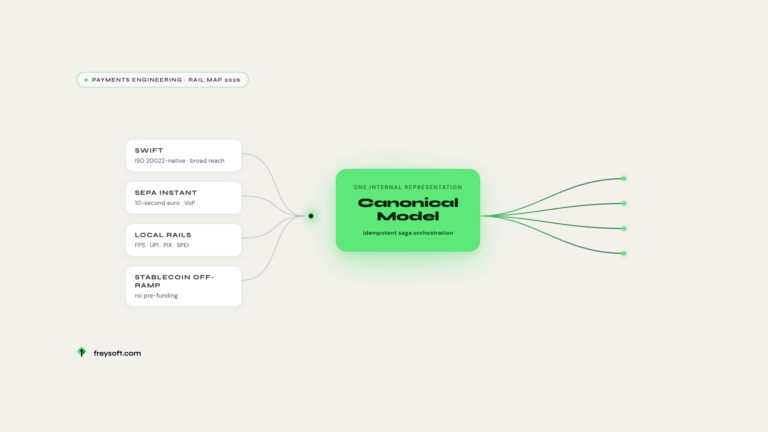
The routing strategies that decide cost, speed, and success rate across SWIFT, SEPA, FPS, local rails, and stablecoin off-ramps
Once a payment operator runs more than one rail, a question appears on every transaction: which rail should this one take? Multi-rail payment orchestration is the engineering that answers it automatically: a routing layer that picks, per transaction, the best path across SWIFT/gpi, SEPA Instant, Faster Payments, local instant schemes, and increasingly stablecoin off-ramps.
The W7 architecture overview placed orchestration in the stack. This piece goes one level down: the actual routing patterns an orchestration layer implements, and when each one earns its complexity.
Pattern 1: Least-cost routing
The most common starting point. For each transaction, the orchestration layer picks the cheapest viable rail given destination, currency, and amount.
It sounds trivial and is not, because “cost” is multi-dimensional: rail fees, FX spread, correspondent-bank charges on SWIFT, and the operational cost of failures. A least-cost router that ignores success rate optimises a number that looks good in a spreadsheet and loses money on retries.
Earn it when: you have overlapping rails to the same destinations and meaningful cost differences between them.
Pattern 2: Success-rate (authorisation-rate) routing
Instead of cheapest, route to the rail most likely to succeed for this transaction profile (destination, amount band, time of day, partner health). A slightly more expensive rail that settles first time beats a cheaper one that fails and forces a retry.
This pattern requires data: you cannot route on success rate without measuring success rate per rail, per corridor, continuously. The orchestration layer becomes a feedback loop, not a static rulebook.
Earn it when: failure and retry costs are material, or customer experience depends on first-attempt success.
Pattern 3: Cascading failover
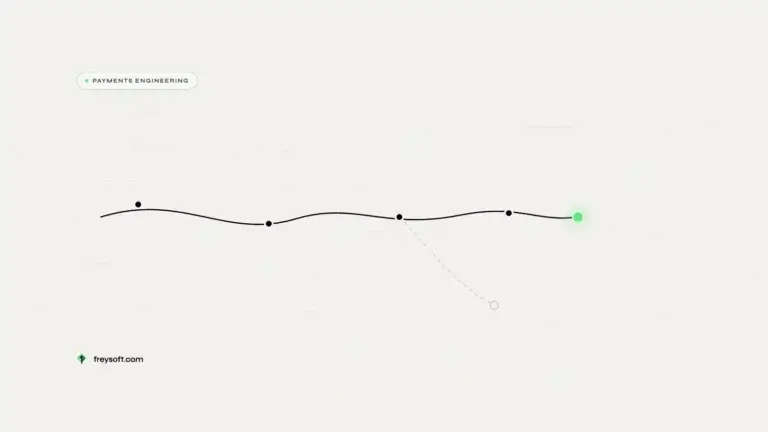
When the primary rail declines or times out, the transaction cascades to a secondary, then a tertiary, automatically, within defined rules, without dropping or duplicating the payment.
This is where reliability engineering and routing meet. Cascading failover is impossible to do safely without idempotency (a retried or cascaded attempt must never double-send) and saga orchestration (each attempt must either complete or compensate cleanly before the next begins). Failover without these primitives is how operators double-pay.
Earn it when: any rail in your mix has non-trivial downtime or decline rates, which is all of them, eventually.
Pattern 4: Liquidity-aware routing
For operators pre-funding accounts or managing FX positions across markets, the best rail also depends on where your liquidity currently sits. Liquidity-aware routing factors available balances and rebalancing cost into the decision, avoiding the trap of routing every transaction over the “cheapest” rail until that account runs dry.
Earn it when: you pre-fund or hold positions across multiple currencies and accounts.
Pattern 5: Time and SLA-aware routing
Some corridors promise speed; some optimise cost. SLA-aware routing sends time-sensitive transactions over instant rails (SEPA Instant, FPS, stablecoin) and batches cost-sensitive ones over slower rails, honouring the promise made to each customer segment.
Earn it when: you sell differentiated speed tiers, or settlement timing affects compliance or treasury.
The pattern underneath all of them: saga orchestration
Every routing pattern above shares a dependency. A cross-border transfer is a multi-step, long-running process (reserve, debit, route, settle, confirm, reconcile), and any step can fail. Saga orchestration is the pattern that makes the whole flow either complete fully or compensate cleanly, never leaving money in an indeterminate state.
Without it, sophisticated routing is dangerous: the more cleverly you route and retry, the more ways a partially-completed transaction can strand funds. Saga orchestration is not optional infrastructure layered under “nice to have” routing; it is the precondition that makes routing safe to attempt at all.
Build the routing engine, or buy a provider?
Payment orchestration providers (Spreedly, Gr4vy, orchestration inside the larger platforms) implement these patterns as a product. If your routing needs are standard, namely least-cost and basic failover across common rails, buying is the right call and faster than building.
Build your own when routing is a differentiator: corridor-specific liquidity optimisation, unusual local rails, custom SLA tiers, or settlement logic the providers do not express. At that point the routing engine is part of how you compete, and renting it caps your edge.
This is the orchestration FreySoft built for WorldRemit (now Zepz): routing transfers across 130+ countries and 70+ currencies, optimised to run 24/7 at over 100,000 payment transactions a day, with the routing and corridor logic owned by WorldRemit. Orchestration that survives that volume and reliability bar is a domain skill, not a generic backend task.
The takeaway
Start with least-cost routing, add success-rate routing once you can measure it, make failover safe with idempotency and sagas before you rely on it, and layer in liquidity- and SLA-awareness as your treasury and product demand. Buy this as a provider if routing is commodity for you; build it if routing is your edge. And if you build it, build saga orchestration first, because every other pattern depends on it.
Building orchestration as part of a wider corridor strategy? See “How fintechs actually add new payment corridors,” or talk to our payments team.