TL;DR. Real-time rails don’t just make payments faster. They change the failure model. Every check that used to run “sometime before the batch window” now has to finish inside a clock measured in seconds, and a settled payment can’t be pulled back. This article covers the three production realities that surprise teams going live on SEPA Instant, UK Faster Payments, and SWIFT gpi: timeout semantics (a missing confirmation does not mean the payment failed), sanctions screening inside the clock (EU regulation has inverted the whole model), and reconciliation when the rail is partially down. It’s written from work on payment infrastructure processing 100,000+ transactions a day across 130+ countries and 70+ currencies. Last updated: July 2026.
The mental-model shift: from batch to irreversible-in-seconds
Batch rails forgive. A standard SEPA Credit Transfer sits in a batch cycle for hours before settlement, and that window is where mistakes get caught: a compliance analyst reviews a flag, a liquidity desk tops up an account, an engineer cancels a mis-keyed file. Instant rails removed the window.
SEPA Instant promises funds on the beneficiary’s account in under ten seconds, 24/7/365. And the clock got tighter, not looser: the 2025 SCT Inst rulebook, in force since 5 October 2025, moved the old 10/20/25-second model to a 5-second target, a 7-second hard time-out, and confirmation to the originator PSP by the 9th second. UK Faster Payments clears in seconds too, though it settles differently (more on that below). Once settled, the payment is final. The 2025 rulebook even limits you to a single recall attempt per transaction. If it gets a negative response, that’s it.
The engineering consequence is simple to state and expensive to learn in production: liquidity checks, sanctions screening, fraud scoring, and format validation all moved inside the rail’s clock. There is no “later.” Either your checks complete in seconds, or the payment fails in front of the customer.
The two rails also differ under the hood, which matters for your fallback and reconciliation design:
| SEPA Instant (SCT Inst) | UK Faster Payments | |
|---|---|---|
| Customer-visible speed | Under 10 seconds | Seconds (scheme tolerance up to ~2 hours in rare cases) |
| Settlement model | Real-time gross settlement per transaction (TIPS / RT1, central-bank money) | Deferred net settlement at the Bank of England, with a Net Sender Cap |
| Message standard | ISO 20022 (pacs.008 / pacs.002) | ISO 8583, migrating to ISO 20022 through 2025–27 |
| Transaction limit | No scheme cap since the 2025 rulebook (PSPs set their own) | £1,000,000 scheme maximum |
| Recent volume / adoption | ~23% of euro credit-transfer volume (ECB, H1 2025), still climbing | 5.09 billion transactions, £4.2 trillion (Pay.UK, 2024) |
Timeout semantics: the #1 production surprise
The scenario every team hits within the first weeks. You send a pacs.008 (the credit transfer). The pacs.002 (the status report) doesn’t arrive in time. Question: did the payment settle?
Answer: you don’t know. And the scheme rulebook explicitly forbids you from deciding. Under the EPC rulebook, the originator PSP may not unilaterally treat a timed-out transaction as failed. Until a negative confirmation arrives, settlement certainty has to be maintained. The confirmation might still show up late; the 2025 rulebook even defines explicit process steps for positive and negative confirmations arriving after the deadline. A timeout is not a failure. It’s a third state.
A conventional state machine has one move here: mark it failed, and often retry. Both are wrong. The payment may have settled at the beneficiary with only the confirmation lost in transit, so marking it failed puts your books at odds with reality, and retrying issues a second credit the recipient is entitled to keep.
Most payment state machines going into their first instant integration have two terminal outcomes, success and fail. That model is wrong on this rail. You need an explicit indeterminate state:
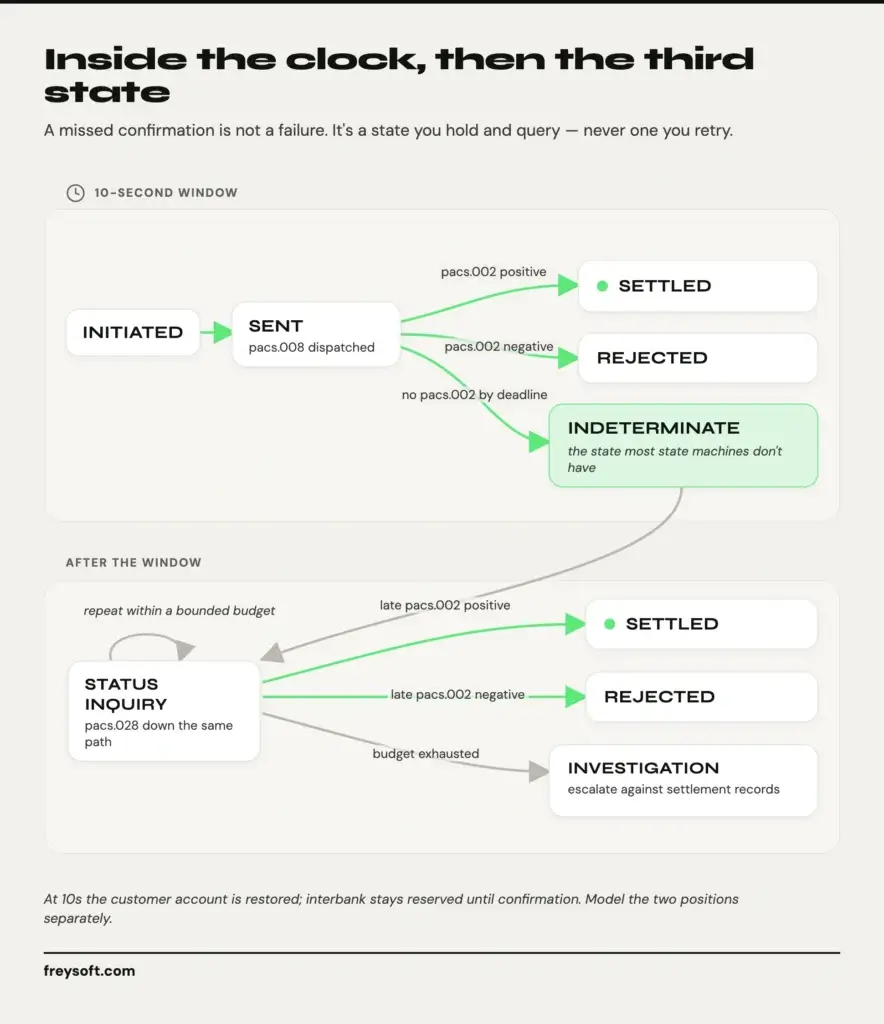
Three things about this state machine that the documentation mentions but doesn’t emphasize.
On timeout, you query. You never blindly retry. The instinct after a timeout is to resend. On an instant rail that instinct produces a duplicate credit, because the first payment may have settled and the confirmation simply got lost. The correct move is to query, not conclude: send a pacs.028 down the same path as the original transaction and wait for the pacs.002 it triggers. The part the documentation underplays is that the inquiry can also return nothing in time. So “unknown” has to be a state the system can hold and re-enter, not a momentary blip, and it needs an exit that isn’t a guess. In practice that means a bounded number of inquiries or a fixed time budget, after which the payment escalates to investigation against the settlement records, rather than looping forever or, worse, resending.
The customer account and the interbank position split at the 10th second. Under the 2025 rulebook, if no confirmation at all has arrived within 10 seconds, the originator PSP restores the customer’s account and the sender sees their money back. But the funds stay reserved on the interbank side until the eventual confirmation arrives. For that window the two positions disagree by design. A ledger with a single balance can’t represent “customer made whole, interbank still committed,” so the first late confirmation after the restore lands as a manual reconciliation break instead of a clean state transition. Teams that model one balance discover this during their first late-confirmation incident.
Underneath all of it is one modelling mistake: collapsing three independent dimensions into one status field. Processing state (sent, awaiting, inquiry open), financial position (reserved, restored, settled), and settlement certainty (confirmed, rejected, unknown) move together on a batch rail and diverge on an instant one. The recovery logic has to read all three, because the safe action after a crash turns entirely on one distinction the schema must capture. “Prepared but never dispatched” is safe to retry. “Dispatched, outcome unknown” must only ever be queried. Everything above is downstream of getting that one bit right, which is also why idempotency is on you: the scheme treats real-time duplicate checking on incoming messages as a CSM-layer concern, and “duplicate sending” is one of the few permitted recall reasons, which tells you how often it happens. Persist a business-level idempotency key to durable storage before the outbound call, bound to a hash of the request body so a changed payload can’t reuse a key. On SWIFT gpi corridors the UETR gives you the same end-to-end reference.
Sanctions screening inside the clock
Here the collision is structural. Traditional sanctions screening assumes a manual review queue: a fuzzy match fires, an analyst looks at it, minutes or hours pass, the payment proceeds or gets blocked. An instant rail gives you seconds, and no hold state to park the payment in.
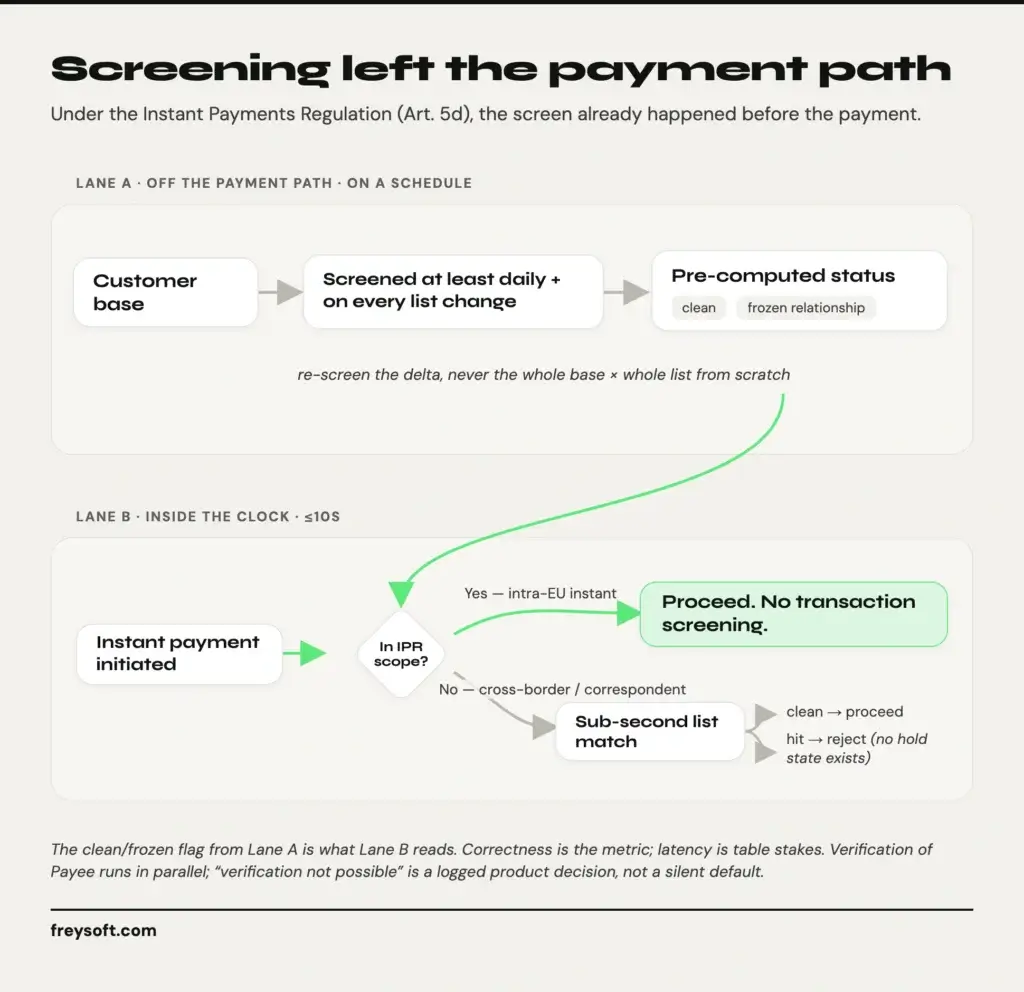
The EU answered this with regulation, and the answer surprised most compliance teams: for in-scope intra-EU instant payments, per-transaction sanctions screening is now prohibited. The Instant Payments Regulation (Regulation (EU) 2024/886, Article 5d) replaced it with customer-base screening at least daily, plus immediate re-screening whenever the sanctions lists change. The logic behind the inversion: the European Commission found that the overwhelming majority of transaction-level flags, on the order of 99.8%, were false alarms. At batch speed a false alarm costs an analyst’s minutes. At instant speed it kills the payment.
What makes this model fast is that the expensive matching happens off the payment path. You screen the customer base on a schedule, and again whenever a list changes, so at transaction time the payment reads a status that has already been computed rather than running a live match inside the rail’s clock. The trade-off is explicit: precomputing buys you speed but opens a freshness window between the last screen and the payment, which is exactly why the regulation mandates immediate re-screening on list changes. The whole game is keeping that window small.
Two things carry most of the speed once you’re off the payment path.
First, structured data. Matching against clean structured names and addresses rather than free-text fields cuts false positives substantially, and every false positive you don’t generate is review work you don’t have to do. That’s why the ISO 20022 structured-address rules below matter more than they look: cleaner input is a screening optimization, not just a compliance checkbox. It doesn’t remove fuzzy matching, since transliteration and name variants still need it, but it shrinks how much fuzzy work each screen carries.
Second, scoping the re-screen correctly. When a list changes, the delta is small, so you match the changed list entries against the full customer base. When a customer is added, you match that customer against the full list. You never re-screen the entire base against the entire list from scratch on every change. That single decision is what turns “immediate re-screening” from an overnight batch into a sub-minute operation.
On our delivery work in SEPA screening, the target we engineered to was screening completion in under one minute with a 0% error rate, and we hit it. The number that matters there is not the minute. It’s the zero. A base-screening model is only as strong as its coverage, and the real risk isn’t a slow screen, it’s a customer who should have been re-screened after a list change, wasn’t, and transacts cleanly in the gap. So the measure that means something is missed matches against a validated test dataset and processing failures across the measured period, not average speed. At instant settlement there’s no review queue behind the control to catch what slips through. The screen is the last line, which is why, on this rail, its correctness is the metric and its latency is just table stakes.
Transaction screening doesn’t disappear entirely. Cross-border and correspondent flows sit outside the regulation’s scope and still need screening inside the clock, matching against sanctions lists in well under a second with fuzzy tolerance tight enough that false positives don’t turn your instant rail back into a queue. Structured data is the highest-leverage fix there too.
Verification of Payee adds one more decision point since October 2025: the payer’s PSP checks the beneficiary name against the IBAN before authorization and returns match, close match, no match, or verification not possible. That last one is the interesting case for engineers. When the payee’s PSP is unreachable, proceeding is allowed but the risk shifts. Model it as an explicit, logged product decision, not a silent default.
Reconciliation when the rail is partially down
The rail documentation describes two states: up and down. Production has a third, partially available. A participant PSP unreachable while the scheme is healthy. A CSM in a degraded mode. Maintenance windows on TIPS or RT1 that mostly don’t affect you until they do. Your architecture meets all of these in the first year.
The most useful signal for partial degradation usually isn’t the error rate. It’s latency creeping up on a dependency before it starts failing outright. A partner taking longer to respond, a CSM slower to confirm, a queue depth climbing on an async leg: all of them move before error counts do, because a slow dependency isn’t throwing errors yet, it’s just answering later. What you watch differs by rail. On an async payout leg it’s queue depth and consumer lag. On the instant leg it’s the time-to-confirmation distribution and the share of transactions approaching the pacs.002 deadline. Either way, rising latency is the leading indicator, and it fires well before the first customer notices.
A latency signal tells you that something’s slow, not where, and on this rail “where” decides what you can do about it. Degradation has to be attributed by level before anyone acts:
- Internal — your gateway, screening, ledger, queues. You can scale or fail over your own component.
- Local connectivity — HSM, certificates, the message gateway to the scheme. This class of failure looks like “we can’t send” rather than “we’re slow.”
- Partner — a beneficiary PSP or correspondent responding slowly.
- Scheme / CSM — TIPS or RT1 degraded, or a maintenance window. This one you cannot fix, and often cannot even route around, because the only alternative is dropping off the instant rail entirely.
Each needs its own dashboard and runbook, because the response is completely different. The failure to design against is misattribution. Chase a scheme incident that’s really your own queue backing up and you lose the minutes that matter. Blame your own stack for a CSM slowdown and you scale a service that was never the bottleneck.
Which is why “just fall back to a slower rail” is a decision, not a default. Routing to standard SCT when the instant path degrades is legitimate, and it changes what the customer was promised. For in-scope eurozone flows it also touches the regulatory obligation to offer instant. Engineering can build the switch. Whether and when to throw it belongs in a product decision, logged deliberately and surfaced to the customer, not buried in a catch block where the first anyone hears of it is a reconciliation break.
Two more things hold up in practice. Your reconciliation has to absorb out-of-order and late confirmations cleanly, because the rulebook permits them: a late positive for a payment you already marked “account restored” reconciles to settled without manual work, and a late negative doesn’t double-reverse. And SWIFT gpi is an observability layer, not a speed guarantee. It gives you end-to-end tracking by UETR across the chain; it does not make the payment instant, and tracking visibility breaks at any intermediary that doesn’t support it. SWIFT’s own network data shows around 90% of cross-border payments reach the beneficiary bank within an hour, but crediting the end customer’s account is a separate, slower leg. Plan reconciliation for that tail.
ISO 20022: where the message format bites
The message layer looks like the boring part. In production it causes a disproportionate share of incidents, and almost all of them trace to the same few spots.
The character set is stricter than teams expect. SEPA restricts payment data to a limited Latin character set. An accented character in a beneficiary name, a reference field that starts with a slash or contains two consecutive slashes, and the payment bounces, correct in every other respect. Different systems handle the violation differently too: some convert, some replace with spaces, some reject outright.
Truncation and optional fields are the second cluster. The same pacs.008, passed through an intermediary with tighter field handling, can arrive with an address truncated below what screening needs.
The trap underneath both is assuming a message that validates will clear. Test against each partner’s environment, and assume it diverges from production. A message that passes schema validation and clears one CSM’s sandbox can still be rejected by a partner or a second CSM that validates the same ISO 20022 type differently. The divergence between TIPS and RT1 in special-character handling is documented, and sandboxes tend to be clean exactly where production is messy. Bilateral testing during onboarding, exercised against real boundary values rather than tidy sample data, is where that surfaces cheaply, before a live payment surfaces it for you.
One date worth having in the plan: from 15 November 2026, unstructured addresses will no longer be permitted in these messages. Beyond compliance, structured addresses feed directly into screening quality, which loops back to the section above. Cleaner input, fewer false positives, faster clock.
What we’d tell a team going live next quarter
Test the timeout path more than the happy path. The happy path will work in the sandbox and in production. The timeout path is where duplicate credits and stuck states are born, and sandboxes rarely simulate a lost pacs.002. Force it: kill confirmations in test and watch what your state machine actually does.
Model three dimensions, not one status field. Processing state, financial position, and settlement certainty diverge on an instant rail. Collapse them into one field and your crash-recovery logic can’t tell “prepared but never dispatched” (safe to retry) from “dispatched, outcome unknown” (only ever query). Get that one distinction into the schema on day one.
Split customer-account state from interbank position in the ledger design. The 10-second account restoration rule means the two legitimately disagree for a window. If your data model can’t represent that disagreement, the first late confirmation becomes a manual reconciliation incident.
Load-test the screening service at rail SLA, not at average load. A screening engine that answers in 300ms at average volume and in 4 seconds at peak has failed the rail’s clock exactly when volume spikes matter most. And measure the right thing: missed matches against a validated dataset, not average latency. On this rail, correctness is the metric.
Test against each partner’s environment, and assume it diverges from production. A message that clears one CSM’s sandbox can be rejected by another partner validating the same type differently. Bilateral testing against real boundary values during onboarding is the cheap place to find it. Integration work against partner test environments takes longer than the docs suggest, so budget it.
Decide the fallback policy in a product meeting, not in a catch block. Who gets routed to a slower rail, when, what the customer sees, and what gets logged. Engineering can build any of the options; choosing one is a business decision with regulatory edges.
Put dates in the roadmap now. The structured-address cutover on 15 November 2026 and, for non-eurozone EEA operators, the 9 January and 9 July 2027 instant-payment obligations. These are calendar facts.
Whether you build this in-house or bring in a team that has run it before is its own decision, and we wrote a separate piece on exactly that trade-off: choosing a payment engineering partner: build, buy, or embed.
About the work behind this article
FreySoft engineers real-time and cross-border payment infrastructure for fintech operators. The experience above comes from production work at remittance scale: infrastructure spanning 130+ countries, 70+ currencies, and 100,000+ transactions a day for WorldRemit/Zepz, including an Azure→AWS migration and delivery results of 47% latency reduction and 50% performance uplift, alongside sub-1-minute SEPA screening at a 0% error rate. If you’re scaling into instant rails and want a team that has already met these failure modes in production, book a scoping session with our payments engineering team.