
TL;DR. Stablecoin settlement has crossed from pilot to production in cross-border payments. Stripe’s 2026 annual letter reports stablecoin payment volume doubling to roughly $400 billion in 2025, about 60% of it B2B; a McKinsey–Artemis analysis independently lands at ~$390 billion of genuine payment activity. The hard engineering problem for a cross-border payment operator is not the on-chain transfer. It is the stablecoin off-ramp: converting USDC into local fiat in the destination market, reconciling on-chain finality against banking-rail finality, and keeping the corridor compliant end to end. This article covers what a production stablecoin off-ramp actually looks like, the six engineering problems that decide whether it works, and where USDC settlement fits inside a multi-rail corridor architecture.
Why stablecoin off-ramps moved into production corridors
For a decade, the default architecture for an emerging-market corridor looked like this: prefund a local partner account, wait for correspondent banking settlement (T+1 to T+3), and absorb the working-capital cost of money sitting idle in a dozen destination markets.
Three forces broke that default:
Correspondent banking retreat. Global banks have spent years de-risking out of exactly the corridors where remittance and B2B payment demand is growing — Sub-Saharan Africa, parts of LatAm, Central Asia. Fewer correspondents means slower settlement, higher costs, and single points of failure per corridor.
Prefunding economics. A cross-border operator running 20 corridors on prefunded accounts is effectively running an internal treasury desk with capital locked in every destination currency. At scale-up growth rates, prefunding requirements grow faster than revenue.
Stablecoin settlement matured — and the numbers are now audited by skeptics. Stripe’s annual letter reports stablecoin payment volume doubled to around $400 billion in 2025, with an estimated 60% representing B2B payments. McKinsey, working with blockchain analytics firm Artemis, stripped out trading, internal transfers, and automated flows and still found roughly $390 billion in genuine stablecoin payments for 2025 — more than double 2024 — including about $226 billion in B2B and $90 billion in remittance-type flows. The infrastructure majors are acting on it: Visa expanded its settlement platform to USDC, EURC, PYUSD, and USDG across Ethereum, Solana, Stellar, and Avalanche, then launched USDC settlement for US banks in December 2025 with over $3.5 billion in annualized stablecoin settlement volume. Mastercard agreed in March 2026 to acquire stablecoin infrastructure provider BVNK for up to $1.8 billion.
Two honest caveats belong next to those numbers. First, ~$390 billion is still roughly 0.02% of global payment volume — stablecoin settlement is a fast-growing niche, not a replacement for the rail mix. Second, headline claims like “stablecoins settled $35 trillion on-chain” describe total on-chain turnover, of which only about 1% is real-world payments. Any corridor business case should be built on the payments number, not the turnover number.
The practical result: for specific corridors — typically EU/UK/US → emerging markets — a stablecoin leg (USDC over Solana, Polygon, or Ethereum L2s) can replace the correspondent leg. Sub-minute settlement, no prefunding of the transit leg, 24/7 availability.
But the transit leg was never the bottleneck. The bottleneck is the last mile.
What is a stablecoin off-ramp?
A stablecoin off-ramp is the infrastructure that converts a stablecoin (typically USDC) received on-chain into local fiat currency delivered through the destination market’s domestic rails — a bank transfer, an instant-payment scheme, or a mobile-money wallet.
In a production corridor, the full flow has three legs:
- On-ramp (origin): fiat is collected from the sender via local rails and converted into USDC — either by the operator’s own treasury or a licensed on-ramp partner.
- Transit (on-chain): USDC moves to the destination-side wallet. This leg settles in seconds to minutes and is the least problematic part of the system.
- Off-ramp (destination): USDC is converted into local currency at an executed FX rate and paid out via the domestic rail — PIX in Brazil, SPEI in Mexico, mobile money in Kenya or Ghana, local bank transfer elsewhere.
The off-ramp is where regulatory licensing, local liquidity, FX execution, and payout-rail integration converge — which is why it is the part of the corridor that determines whether the whole design works.
Six engineering problems that decide whether a stablecoin off-ramp is production-ready
1. Two definitions of finality
On-chain finality and business finality are different events. USDC arriving in a destination wallet is cryptographically final; the customer payout is not complete until the local rail confirms delivery — and local rails fail, bounce, and time out. A production off-ramp needs an explicit state machine that treats “on-chain settled” and “payout delivered” as separate states, with defined compensation logic for the gap: what happens to funds that are final on-chain but rejected by the destination bank?
This is the same class of problem as any multi-leg corridor flow, and it responds to the same pattern: Saga orchestration with deterministic workflows and compensating transactions, rather than event choreography that lets partial failures ripple implicitly.
2. Idempotency across the chain boundary
Blockchain interactions add a new flavor of the classic async-webhook problem. Chain reorganizations (rare on modern L1s/L2s, but nonzero), RPC-node timeouts, and webhook retries from off-ramp providers all create scenarios where the same settlement event is observed twice — or appears to be missing and is retried. Without idempotency keys spanning both the on-chain transaction hash and the internal transfer ID, duplicate payouts are not a hypothetical. They are the first production incident most teams hit.
3. Ledger reconciliation across three systems of record
A stablecoin corridor has at least three ledgers: the internal transaction ledger, the chain itself, and the off-ramp partner’s payout records. They will disagree — timing differences, dust amounts from gas handling, FX rounding at conversion. Production operations require automated three-way reconciliation with defined tolerance thresholds and exception queues, not an analyst with a spreadsheet. Operators that already run data-lake reconciliation across banking rails can extend the same infrastructure; chain data is just another source to normalize.
4. FX execution at the off-ramp
The USDC→local-currency conversion is a real FX trade, executed either by the off-ramp partner or the operator’s own liquidity setup. The engineering questions are the same as any FX desk integration: when is the rate locked relative to the customer quote, who carries the slippage between quote and execution, and how is the spread captured in the ledger? In volatile EM currencies, a quote-to-execution gap of hours can erase corridor margin. Rate-lock windows and hedging logic belong in the corridor design, not in a post-launch patch.
5. Compliance is not lighter — it is differently shaped
A stablecoin leg does not reduce compliance obligations; it rearranges them. Transaction screening and sanctions checks still apply to sender and recipient. The FATF Travel Rule applies to the on-chain leg above thresholds, which means originator/beneficiary data must travel alongside the transfer through compliant channels. Wallet screening (checking destination addresses against sanctioned-address lists) is an additional screening surface that fiat corridors do not have. Under MiCA in the EU and the post-GENIUS-Act regime in the US, licensing of both the stablecoin issuer and the ramp providers is now a due-diligence item — one reason USDC, with a regulated issuer and attested reserves, dominates production payment flows over less transparent alternatives.
6. Partner failure and depeg contingency
Off-ramp partners are the new correspondent banks — and they fail the same ways: liquidity shortfalls in the destination currency, API outages, license suspensions. A production corridor treats the stablecoin route as one rail among several, with health checks, circuit breakers, and automated fallback to an alternative off-ramp partner or a traditional rail. The same logic covers the tail risk of a stablecoin depeg event: routing rules should reference live redemption conditions, not assume 1:1 forever.
Where a stablecoin off-ramp fits in a multi-rail architecture
The strongest argument for the stablecoin leg is also the strongest argument against building it as a special case: it is just another rail.
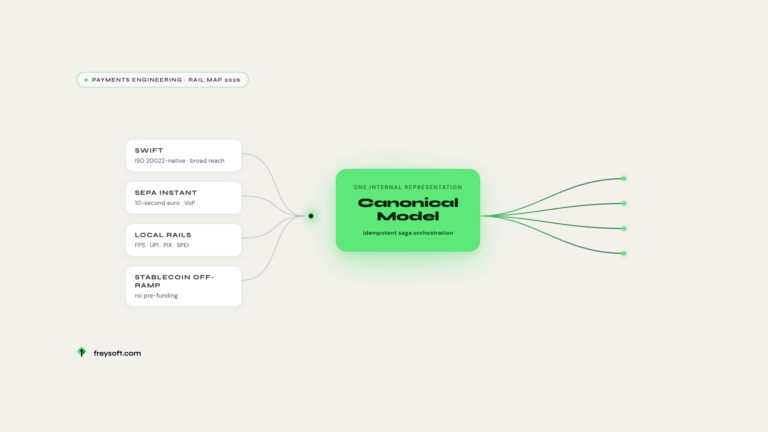
In a connector-based multi-rail corridor architecture, each rail — SWIFT gpi, SEPA Instant, FPS, UPI, PIX, SPEI — sits behind a dedicated connector that translates the rail’s protocol into an internal canonical transaction model. A stablecoin off-ramp slots into exactly the same pattern: the connector encapsulates chain interaction, off-ramp partner APIs, and FX execution, and exposes the same canonical interface as every other rail.
That design buys the outcome that matters commercially: per-transaction routing optionality. For an EU→Africa payment, the router can choose between a traditional correspondent route and a USDC off-ramp route based on live cost, speed, and partner health — without the product layer knowing or caring which rail executed. When a better off-ramp partner appears in a market, swapping providers is a connector change, not a platform rewrite.
Operators who wire the stablecoin leg directly into the core as a bespoke integration recreate the exact point-to-point debt that multi-rail architecture exists to eliminate — with the added complexity of a chain boundary running through it.
When a stablecoin off-ramp is the right call — and when it isn’t
| Signal | Favors stablecoin off-ramp | Favors traditional rails |
|---|---|---|
| Corridor destination | EM markets with weak correspondent coverage, strong local instant rails or mobile money | Markets with deep, cheap correspondent or direct-rail access |
| Prefunding cost | High working-capital drag across many destination currencies | Prefunding already efficient or netted |
| Settlement urgency | 24/7 or weekend settlement is a product requirement | Batch T+1 acceptable |
| Volume profile | B2B treasury flows, high-value remittance corridors | Low-value, high-frequency corridors where off-ramp fees dominate |
| Regulatory posture | Destination market has clear VASP/ramp licensing | Regulatory ambiguity around crypto-fiat conversion |
| Existing architecture | Connector-based multi-rail platform (incremental rail add) | Monolith where any new rail is a project |
The honest summary: stablecoin off-ramps are a corridor-level decision, not a platform-level religion. The cross-border operators getting value from USDC settlement in 2026 are the ones treating it as one more entry in the routing table.
The engineering behind it
FreySoft builds payment-corridor infrastructure for cross-border operators — the connector layers, orchestration workflows, ledger and reconciliation systems that let a platform add rails without re-architecting. Our engineers built and scaled corridor infrastructure at WorldRemit as it expanded across 130+ countries and 70+ currencies at 100,000+ daily transactions, and the same multi-rail patterns — canonical transaction models, Saga orchestration, three-way reconciliation — extend directly to stablecoin settlement legs.
If you are evaluating a USDC off-ramp for a specific corridor and want an engineering view on the architecture — connector design, finality state machines, reconciliation, partner-failover logic — book a 30-minute call with our team.
FAQ
A stablecoin off-ramp is the infrastructure that converts a stablecoin such as USDC into local fiat currency in the destination market and delivers it through domestic payment rails — bank transfer, instant-payment schemes, or mobile-money wallets.
Around $390–400 billion in genuine payment activity in 2025 by both Stripe’s and McKinsey–Artemis’s independent counts — roughly double 2024, but still about 0.02% of global payment volume. Headline $35 trillion figures describe total on-chain turnover, of which only about 1% is real-world payments.
USDC dominates production payment flows because its issuer is regulated and its reserves are transparently attested, which simplifies partner due diligence under regimes like MiCA in the EU. Institutional settlement programs, including Visa’s, supported USDC first.
No. Sanctions screening and AML monitoring still apply, the FATF Travel Rule covers the on-chain leg, and wallet-address screening is an additional obligation fiat corridors don’t have. Compliance is differently shaped, not lighter.
As one more rail behind a dedicated connector. The connector encapsulates chain interaction, off-ramp partner APIs, and FX execution, exposing the same canonical interface as SEPA, FPS, or PIX connectors — enabling per-transaction routing between stablecoin and traditional routes.
The gap between on-chain finality and payout finality. Funds can be final on-chain but rejected by the destination bank, so the system needs an explicit state machine with compensation logic — plus idempotency spanning transaction hashes and internal transfer IDs to prevent duplicate payouts.
Sources
- Stripe, 2025 Annual Letter (Feb 2026) — stablecoin payment volume doubled to ~$400B in 2025, ~60% B2B.
- McKinsey & Company (with Artemis Analytics), Stablecoins in payments: What the raw transaction numbers miss (18 Feb 2026) — ~$390B genuine payments (annualized from Dec 2025 activity), ~$226B B2B, ~$90B remittances, ~0.02% of global payments.
- Visa Inc., Visa Expands Stablecoin Settlement Support (31 Jul 2025) — USDC, EURC, PYUSD, USDG across Ethereum, Solana, Stellar, Avalanche.
- Visa Inc., Visa Launches Stablecoin Settlement in the United States (Dec 2025) — USDC settlement for US issuers/acquirers; $3.5B+ annualized stablecoin settlement volume.
- Mastercard, Mastercard to acquire BVNK to connect on-chain payments and fiat rails (17 Mar 2026) — definitive agreement, up to $1.8B incl. $300M contingent.