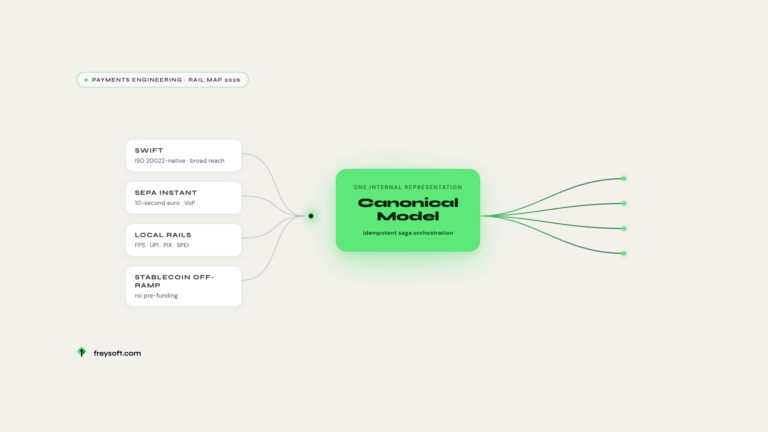

“Build vs buy” is usually argued about the whole payment stack. But the stack is not where the decision actually bites — corridor logic is. A platform can give you acquiring, a wallet, a ledger. The part that decides whether you can profitably enter the next market is the corridor: the routing, the banking-partner connections, the settlement path, the reconciliation, the failure handling for that specific country-and-rail combination. That is the real cross-border payment integration question, and it is narrower than the stack-wide one.
So narrow it down. Forget the whole stack for a moment. The build vs buy payment decision only bites at the corridor level — so for your corridor logic specifically, here are the five questions that decide build versus buy.
Question 1: Is this corridor a differentiator, or table stakes?
If the corridor is somewhere your competitors already are, and customers expect it to simply work, that is table stakes — and buying coverage from a platform or payout network is often the right call. Do not build a commodity.
If the corridor is somewhere you intend to win — a market where better pricing, faster settlement, or local-rail support is your edge — that logic is a differentiator, and differentiators belong in code you own.
Build signal: the corridor is part of how you compete. Buy signal: it is part of how you keep up.
Question 2: Does an off-the-shelf provider actually cover it — fully?
“Supported” and “fully covered” are different claims. A provider may support a country but not the specific local rail you need, the settlement timing your treasury requires, or the reconciliation granularity your finance team needs to close the books.
Map your real requirements against what the provider does natively — not what is on a roadmap. Every gap between the two is something you will end up building anyway, bolted onto a system you do not control.
Build signal: material gaps between your needs and native coverage. Buy signal: clean, full native fit.
Question 3: What does the economics look like at 10x volume?
Per-transaction pricing is the friendliest number in fintech at launch and the least friendly at scale. Model the corridor’s cost at ten times today’s volume. If bought capability stays comfortably profitable, buy. If the per-transaction tax eats your margin as you grow — which is common on high-volume corridors — owning the logic changes from a cost into a saving.
The model is simple: compare the per-transaction fee x projected volume against the integration cost of building plus the annual cost of maintaining owned corridor logic. Buying wins until the fees cross the owned line; on high-volume corridors that crossover usually arrives sooner than the launch math suggests.
Build signal: margin compression at volume. Buy signal: economics hold at 10x.
Question 4: Do you need to own the logic — for IP, audit, or independence?
Some businesses can be indifferent to who owns the corridor code. Many cannot:
- Valuation: investors may price owned payment IP differently from rented capability.
- Audit: regulators increasingly want to see *how* money moves, with explainable, owned logic.
- Independence: if a provider’s pricing or roadmap can hold your expansion hostage, that is strategic risk.
Build signal: ownership matters for value, audit, or independence. Buy signal: ownership is genuinely indifferent.
Question 5: Can you build and maintain it — not just ship it?
A corridor is not a project; it is a living system that must run 24/7, survive a banking partner’s outage, and reconcile correctly every day. Building it is the easy half. Maintaining it — observability, idempotent retries, incident response across timezones — is the half that decides whether “build” was wise.
This is where the third option enters: if you should own the logic (Questions 1–4 say build) but cannot staff the senior payment engineering to build and hold it, an embedded specialist partner handles the corridor development on your codebase, leaves you owning it, and can stay for the maintenance. You get the build outcome — the full payment corridor integration, owned — without the permanent headcount.
Build-in-house signal: you have and can hold senior payment engineering. Embed signal: you should own it but cannot staff it. Buy signal: Questions 1–4 already pointed to buy.
The framework in one table
| Question | Lean BUY | Lean BUILD / EMBED |
|---|---|---|
| 1. Differentiator? | Table stakes | Competitive edge |
| 2. Native coverage? | Full fit | Material gaps |
| 3. Economics at 10x? | Holds | Margin compression |
| 4. Need to own logic? | Indifferent | IP / audit / independence |
| 5. Can build and maintain? | — | Yes → build · Not staffed → embed |
If you land on “buy” across the board, buy — and don’t let anyone talk you into building a commodity. If you land on “build/embed,” the only remaining question is whether you build it in-house or embed a partner to build it with you. That is a capacity question, not a strategy one.
The expensive path is buying when Questions 1–4 said build, hitting the coverage ceiling on corridor #4, and rebuilding under deadline. Five questions, asked early, are cheaper than that rebuild.
Decided you should build or embed your corridor logic? The next question is the architecture itself — how fintechs actually add new payment corridors. Or talk to our payments team.