
Content:
- Challenges of the EdTech industry in 2023
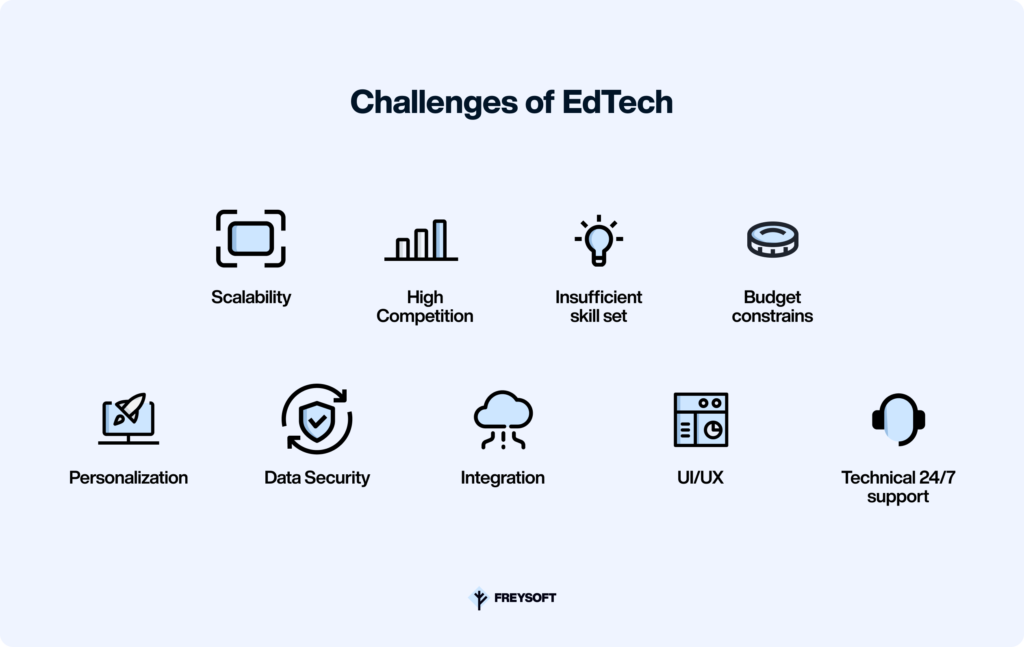
1.1. Scalability
1.2. Ever-rising competition
1.3. Insufficient skill set
1.4. Budget constraints
1.5. Personalization and adaptive learning
1.6. Data security and privacy
1.7. Integration
1.8. User experience and interface design
1.9. Technical 24/7 support - Benefits of outstaffing services for EdTech products
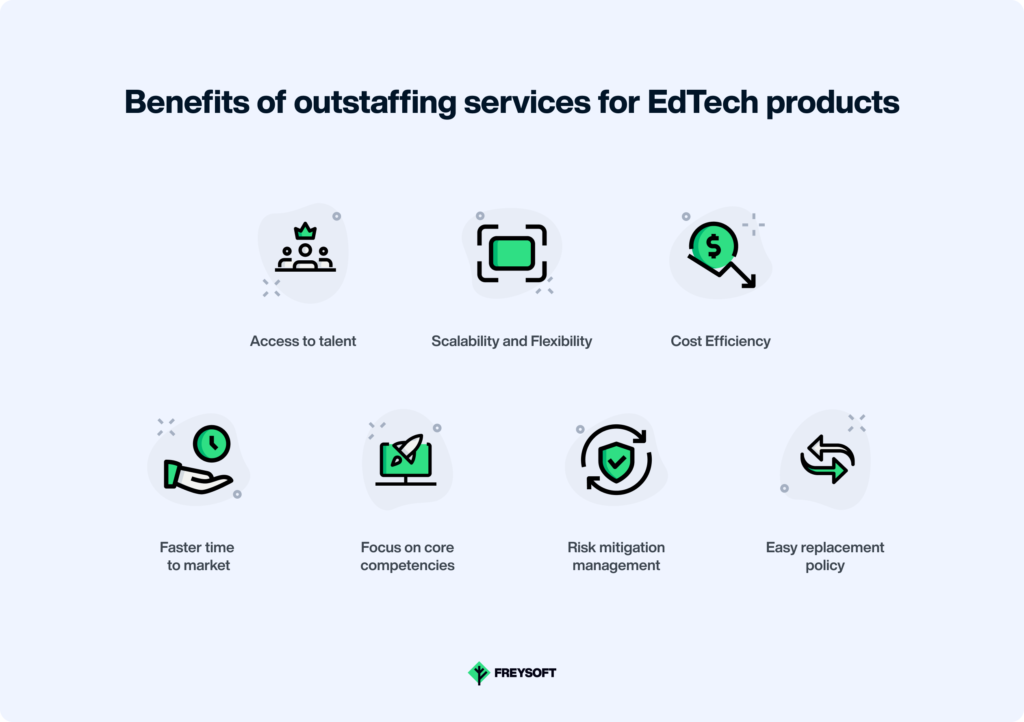
2.1. Access to specialized talent
2.2. Scalability and flexibility
2.3. Cost efficiency
2.4. Faster time to market
2.5. Focus on core competencies
2.6. Risk mitigation & easy replacement policy - Conclusion
1. Challenges of the EdTech Industry in 2023
The EdTech industry is experiencing a significant rise in prominence today. The reason is simple: with the global population growing by 200,000 people every day, we are projected to have an additional 1 billion people on Earth by 2030. As a result, the education sector needs to scale up and improve sustainability to meet the growing demand.
But what challenges does the EdTech industry currently face? And how can outstaffing services for EdTech help solve them?
1.1. Scalability
First and foremost, EdTech businesses need to demonstrate results to a demanding academic audience. They must be capable of handling a large number of concurrent users and accommodating expanding user bases. Scaling the infrastructure, such as servers, databases, and networks, becomes crucial to prevent performance degradation and downtime during peak usage periods.
1.2. Ever-rising competition
Secondly, the EdTech domain faces ever-increasing competition. The target audience no longer seeks another mediocre tool for education or learning management systems (EMS or LMS). If you still believe in this approach, it’s better to reconsider, as it will not take an EdTech company far or attract additional funding. To stay competitive, it is necessary to make a difference and stand out from the crowd of similar products.
1.3. Insufficient skill set
According to recent studies, a bad hire can cost up to 30% of an employee’s wages in the first year. Simple calculations make it obvious that if an employee earns $80,000 per year, the company would lose nearly $24,000 if this employee is unsuitable.
The education sector demands well-versed professionals who can adapt to technological advancements in an ever-changing landscape. Lack of technological expertise and difficulties in keeping up with industry standards have become the most common challenges within the industry. To ensure top-notch performance from your team, it is highly important to recruit proficient individuals with relevant hard and soft skills.
1.4. Budget constraints
It’s important to consider that consumers often have budget constraints when it comes to implementing new technologies, especially in public schools. They are also skeptical about how they can benefit from a new EdTech product.
On the flip side, making robust and cutting-edge technological decisions requires significant resources from your company. Maintaining the technological infrastructure required for running EdTech platforms, including servers, storage, and networking, can be expensive. Therefore, it’s crucial to balance the cost of infrastructure while ensuring affordability for users.
1.5. Personalization and adaptive learning
To cater to the diverse learning styles and individual needs of consumers, the EdTech platform should offer personalized learning experiences. Today, it is no longer surprising to involve artificial intelligence (AI) and machine learning algorithms to achieve this. AI is necessary for tracking and analyzing learners’ data, providing customized recommendations, and adapting content and delivery based on individual progress.
Having relevant high-quality AI and ML engineers on board increases the chances of presenting a successful and efficient EdTech product that meets the demanding needs of the target audience.
1.6. Data security and privacy
EdTech platforms deal with vast amounts of sensitive student and teacher data, including personal information and learning analytics. Therefore, robust data security measures, encryption, secure authentication, and compliance with privacy regulations such as GDPR (General Data Protection Regulation) or CCPA (California Consumer Privacy Act) are crucial. These principles ensure the protection of users’ information and help maintain trust in the platform.
1.7. Integration
When integrating with custom educational systems, learning management systems (LMS), or other software used by educational institutions, you will inevitably encounter integration and compatibility challenges. Different data formats, standards, or technology stacks can make this task difficult for your team. It is essential to have relevant specialists who can effectively address these issues in a timely manner. Seamless integration enhances the user experience and reduces administrative overhead, which is key to the success of your product.
1.8. User experience and interface design
A solid EdTech product cannot exist without a user-friendly design. Intuitive, appealing, and easy-to-navigate interfaces are vital for EdTech platforms. Your product should ensure a positive learning experience based on user experience (UX) research and continuous improvement based on feedback. Keep in mind that your consumers have different levels of experience with technical solutions. Therefore, it is important to remain open-minded and create a design that is as effortless and comprehensive as possible.
1.9. Technical 24/7 support
EdTech platforms should provide comprehensive training and support to their users. This includes assistance in navigating the platform, effectively utilizing its features, and troubleshooting technical issues that may arise. Timely and responsive support channels are crucial for fostering user satisfaction, which ultimately leads to the success of your product.
To address these technological challenges effectively, it is crucial to implement a well-balanced combination of robust software development practices, a strong team of professionals that offers scalability, user-centered design principles, and a commitment to continual innovation and adaptation to emerging technologies.
And now, continue reading to learn about the services that can help EdTech platforms implement this combination and stay ahead of the curve.
You might be also interested in:
Recruitment Process Outsourcing (RPO) for business: Everything you need to know
Delivery team as a subscription service: Who needs this and why
Offshore Software Development Rates by Country in 2023
2. Benefits of outstaffing services for EdTech products
Clearly, high-quality technical specialists are needed to address the aforementioned challenges. It goes without saying that finding, hiring, and onboarding skilled front-end developers is tough, expensive, and time-consuming. The competition for these talents is so intense that in-house recruiters often struggle to fill positions in a timely manner. This situation worsens when you realize that while you’re desperately searching for a candidate with the right skill set at an affordable rate, your competitors may be releasing new features and innovative solutions.
Moreover, if you’re a startup, it’s crucial to focus on establishing an efficient onboarding process and a system for retaining tech talent. Attracting new professionals and ensuring their long-term commitment to your company is paramount.
Outstaffing services, also known as staff augmentation, offer a flexible outsourcing model that allows EdTech businesses to hire skilled IT professionals on a temporary or permanent basis. Let’s explore the benefits of this model, which can help businesses tackle the majority of the aforementioned challenges.
Here are the key advantages:
2.1. Access to specialized talent
As an EdTech company, you require a diverse skill set, including software developers, UX/UI designers, data analysts, and instructional designers. Outstaffing services provide access to a global talent pool, offering highly skilled professionals with expertise in the specific areas you need.
2.2. Scalability and flexibility
The EdTech industry experiences periods of rapid growth and fluctuating demand, closely tied to the academic lifecycle. Outstaffing services enable you to quickly scale your team up or down, ensuring a workforce that matches the ever-changing needs of your business. Whether you need to expand your development team for a new project or downsize during slower periods, outstaffing provides the flexibility to adjust accordingly.
2.3. Cost efficiency
From our experience, reputable outstaffing services with a strong customer focus can save up to 50% in hiring costs compared to the local in-house market. By partnering with a trusted provider, you can save on expenses such as recruitment, training, benefits, and infrastructure. Working with outstaffing providers in regions with lower labor costs allows you to access top talent at more competitive rates.
2.4. Faster time to market
We’ve already mentioned the ever-increasing competition in the EdTech market. To stay competitive, your company needs to be agile and release products quickly. Outstaffing services offer the advantage of rapid team mobilization. You can onboard skilled professionals who are already experienced in your industry, leveraging their expertise to accelerate development cycles and bring your products to market faster.
2.5. Focus on core competencies
By outsourcing specific tasks or projects to an outstaffed team, you can free up your internal resources to focus on your core competencies. Many of our clients express relief as they can finally dedicate time to strategic initiatives such as product innovation, market expansion, or enhancing the overall user experience.
2.6. Risk mitigation & easy replacement policy
Outstaffing services help mitigate the risks associated with talent management. You can easily acquire and replace specialists if needed. Furthermore, reputable outstaffing providers offer trial periods at affordable prices, allowing you to ensure that you are working with the right partner. Outstaffing partners handle administrative tasks, HR responsibilities, and legal compliance, while you can concentrate on your core business activities.
Additionally, reputable outstaffing providers have robust security measures in place to protect your intellectual property and data, eliminating concerns about data protection.
3. Conclusion
As you can see, outstaffing services offer significant advantages to EdTech businesses. But
most importantly, they help overcome the challenges faced by the industry. By accessing specialized talent, achieving scalability and flexibility, optimizing costs, speeding up time to market, focusing on core competencies, and mitigating risks, companies can stay ahead of the curve and achieve sustainable growth.
However, to fully capitalize on these benefits, it’s crucial to choose a reliable and experienced provider that aligns with your specific needs and requirements. If you need a step-by-step plan on how to select the right provider, feel free to contact us, and we’ll offer you practical tips to implement today. Moreover, if you’re interested in learning more about how to choose the right outstaffing provider or if you need assistance in implementing an outstaffing strategy for your EdTech business, don’t hesitate to contact us. Our team is ready to provide you with a step-by-step plan tailored to your requirements.
Embrace the opportunities offered by outstaffing services and position your EdTech company for success in the dynamic and competitive landscape of 2023 and beyond.